"How long does it take?" is the second question every homeowner asks after price. The on-site work is usually less than people expect. The waiting in between stages is usually more. Here's an honest end-to-end timeline so you can plan around it.
The fast answer
For a typical residential driveway in Utah:
- First call to quote: 2–7 days
- Quote to scheduled start date: 1–4 weeks (peak season can be longer)
- On-site work: 1–3 days
- Foot traffic: 24 hours after final layer
- Drive on it: 2–3 days after final layer
- Park heavy vehicles or boats: 14–30 days
So: roughly 3–6 weeks from first call to "fully usable driveway." The on-site portion is just a few days of that.
Stage 1: Site visit and quote (2–7 days)
After you reach out, a real estimator comes out, measures the project, looks at access and slope, and writes you a quote on the spot or within a day or two. Things that slow this down:
- Peak season (May–August in Utah) — calendars get full
- Bear Lake / remote locations — we batch trips up
- Commercial work requiring measurements, drainage analysis, or HOA review
If a contractor takes more than a week to get you a quote without explanation, that's a flag.
Stage 2: Scheduling (1–4 weeks)
This is where most homeowners get surprised. The actual job is fast, but the calendar isn't. Two big factors:
Weather windows
Asphalt needs the right temperature to install correctly — generally above 50°F on the ground for the install, and dry conditions for at least 24 hours after. In Utah, that's mid-April through mid-October. May, June, and September are the sweet spots. July is hot enough that scheduling around afternoon thunderstorms gets tricky.
Where you are in the queue
Good crews book up. In peak season, expect a 2–4 week wait once you sign the quote. In April or October (shoulders of the season), 1–2 weeks is more typical.
Stage 3: Tear-out and grading (½ to 1 day)
If there's an existing surface (old asphalt, concrete, dirt), it gets removed and hauled off. Then the base is graded — meaning the soil and aggregate are leveled and shaped for proper drainage.
For a typical residential driveway, this is half a day. For a long or sloped driveway, or one with serious drainage problems, this can take a full day.
Stage 4: Base prep (½ to 1 day, sometimes overnight)
Road base aggregate goes down, gets graded again, and gets compacted with a roller. In most jobs, the base is done the same day as grading. Sometimes we let the base settle overnight, especially on bigger jobs or if rain is coming.
This stage is invisible once the asphalt goes on top, which makes it the easiest place for shortcuts. Quality crews don't shortcut here.
Stage 5: Asphalt install (½ to 1 day)
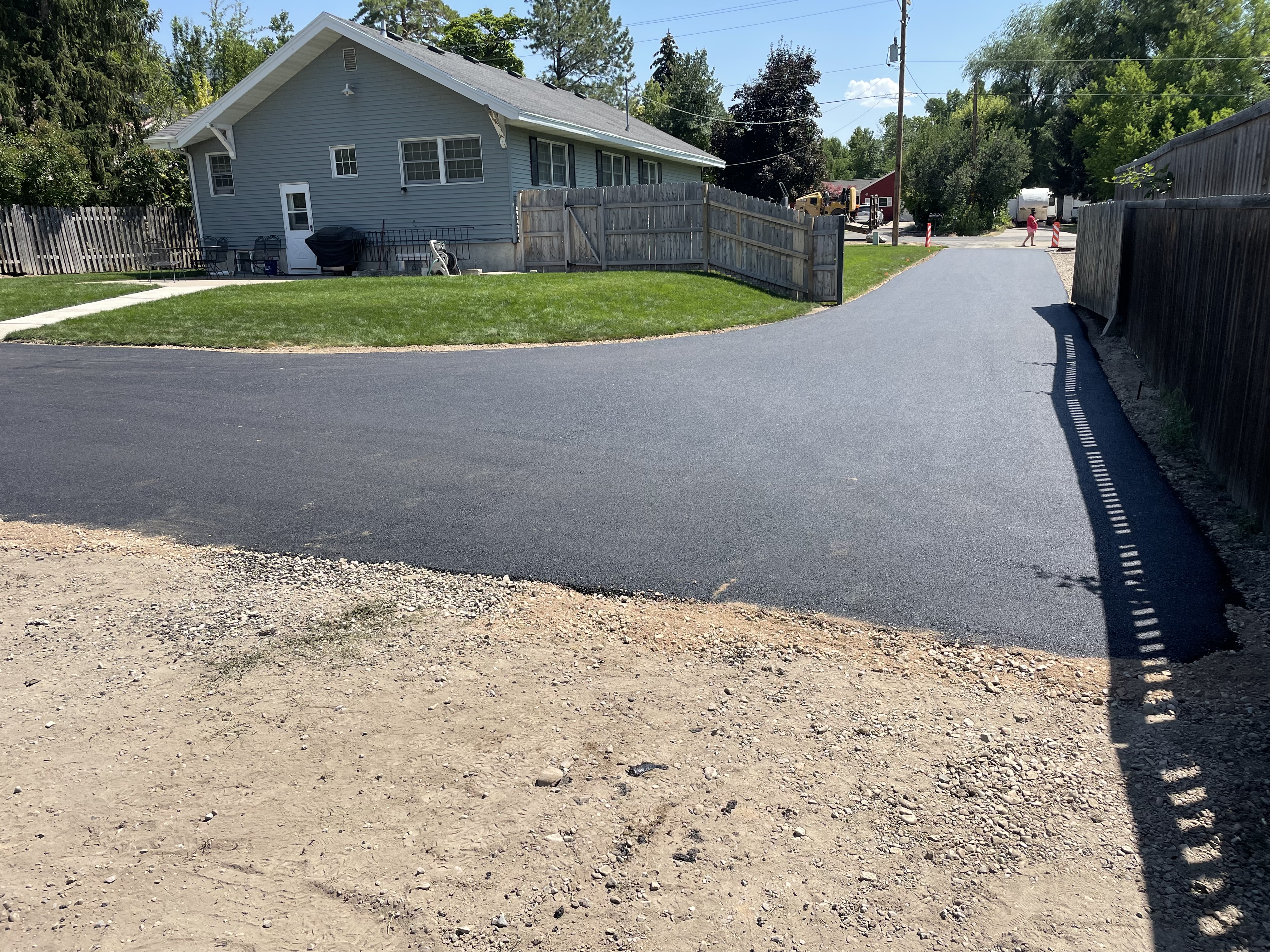
This is the dramatic part — the truck arrives steaming with hot asphalt, the crew spreads and rakes, the roller compacts. For an 800–1,200 sq ft residential driveway, install is usually a single afternoon.
For larger commercial lots, install can span 2–4 days, especially if we're laying multiple lifts (binder course + surface course).
Stage 6: Cooling and curing (the part you can't rush)
Once the last roller pass is done, asphalt has to cool. Here's the realistic timeline:
- 4–6 hours: Cool to the touch
- 24 hours: Safe for foot traffic
- 48–72 hours: Safe for normal car traffic
- 14 days: Mostly cured, but still soft enough that a heavy point load (kickstand, sharp jack pad) can leave an impression
- 30 days: Fully cured for normal use
- 6–12 months: Final curing complete — ready for first sealcoat
Things that can leave permanent marks in the first 30 days:
- Motorcycle / bicycle kickstands
- Vehicle jacks without a wood pad underneath
- Tight turns on a hot day (tires can tear new asphalt)
- Parking a heavy RV or trailer in the same spot for days
Easy fix for all of these: use a piece of plywood as a load-spreader for the first month if you need to park heavy or use a jack.
Where jobs slow down
If you've heard horror stories about paving jobs dragging on, it's usually one of these:
- Weather. Rain pushes start dates. There's no way around it — you can't lay asphalt in the rain or onto a wet base. We'll always be honest if we need to push a date.
- Discovery during tear-out. Sometimes we find buried surprises — old septic, irrigation lines, soft soil pockets. We deal with it, but it can add half a day.
- HOA or permit delays. Rare on residential, more common for commercial. We help with the paperwork, but the calendar isn't ours to control.
- Material availability. Hot asphalt is mixed daily at the plant. If a plant has a mechanical issue or a high-priority municipal job that day, we may need to shift one calendar day.
What a typical week looks like
For most homeowners, this is what the project week looks like:
- Monday: Crew arrives, tear-out and grading complete by end of day.
- Tuesday: Base prep complete by midday, asphalt installed by late afternoon.
- Wednesday morning: Driveway looks great. You can walk on it. We come back to check it.
- Thursday or Friday: You drive on it for the first time.
Or it gets stretched a day if a thunderstorm rolls through. Either way — under a week of disruption for a 20+ year improvement to your home.
How to plan around it
A few homeowner-friendly tips:
- Schedule a paving job in May or September if you can — sweet spot for weather + availability
- Have a backup parking plan for the install week (street, neighbor, etc.)
- Don't book it the week of a big event at your house. Weather can shift it a day.
- Plan the first sealcoat for the following summer — it's part of the lifetime cost
Ready to put it on the calendar?
Get a free estimate and we'll give you a realistic start window — including the weather buffer — so you can plan around it.
Or call us at (435) 310-4694.
Related reading:
Need help with your asphalt project?
Free estimate, written quote, no pressure. We'll be out within 48 hours.